What Dili’s Architecture Reveals About Timor-Leste’s Soul
Walking through Dili, you don’t just see buildings—you feel history. Colonial facades, Portuguese tiles, and modern concrete stand side by side, telling stories of resilience and identity. I never expected such depth in a city so quiet on the map. The architectural blend isn’t accidental; it’s a living record of culture, struggle, and rebirth. This is more than sightseeing—it’s understanding a nation through its streets. Every alleyway, every weathered wall, carries whispers of resistance, faith, and renewal. Dili does not shout its past; it speaks in subtle rhythms, in the curve of a wrought-iron balcony or the alignment of a sacred house. To truly know Timor-Leste, one must look beyond headlines and statistics and walk slowly through its capital, where architecture becomes a language of survival and hope.
First Impressions: The Cityscape of Dili
Dili unfolds with a quiet dignity. Unlike bustling Southeast Asian capitals, it moves at a gentler pace, its skyline low and uncluttered. The city stretches along the northern coast of Timor-Leste, hugging the shimmering waters of the Savu Sea. Its central layout follows a colonial grid pattern, with wide, sunlit boulevards like Avenida de Portugal cutting through the heart of the city. These roads, lined with flame trees and frangipani, create long, shaded corridors that invite walking and conversation. The visual rhythm is one of contrast—old and new, formal and informal, preserved and repurposed. Buildings rarely rise above three or four stories, giving the city an intimate scale. This low-rise character is not just aesthetic; it reflects both tropical urban planning and a history shaped by constraint and recovery.
Key zones anchor the city’s identity. Praça Dom Francisco, a central square named after a beloved bishop, serves as a civic heart. Surrounded by government offices and religious buildings, it is a place of gatherings, quiet reflection, and occasional protest. Nearby, Avenida de Portugal remains one of the most symbolic streets, its name a nod to centuries of colonial rule. Here, remnants of Portuguese-era architecture stand beside modern institutions funded by international development. The waterfront, known locally as the Dili Bay Promenade, offers a different experience—open, breezy, and increasingly used for recreation. Families stroll in the evenings, children play near fountains, and fishermen mend nets along the docks. The sound of waves blends with distant chatter, creating a sensory backdrop that softens the city’s more formal edges.
The city’s layout reveals layers of influence. Portuguese planners designed Dili with broad avenues to allow airflow and military control, but today these spaces serve democratic and communal purposes. The placement of administrative buildings near the sea was strategic in the colonial era, yet now they face public plazas where citizens gather. This shift in function—from control to connection—mirrors the nation’s journey. Sunlight plays a key role in the city’s character, glinting off faded stucco walls and tiled roofs. The tropical light is intense, bleaching colors over time, giving many buildings a soft, sun-washed appearance. It is in these details—texture, light, and space—that Dili begins to tell its story.
Portuguese Colonial Legacy in Stone and Tile
Among Dili’s most enduring architectural imprints are the structures left behind by Portuguese rule, which lasted over four centuries. Though many were damaged during periods of conflict, especially in 1999, several colonial-era buildings still stand as quiet witnesses to the past. These include former administrative offices, schools, and residences, often constructed with thick masonry walls, high ceilings, and large arched windows. The design was not merely aesthetic; it responded to the tropical climate. Thick walls provided insulation against heat, while high ceilings allowed hot air to rise, creating natural ventilation. Interior courtyards, though less common in Dili than in other former Portuguese colonies, occasionally appear in older homes, offering shaded spaces for family life and cooling airflow.
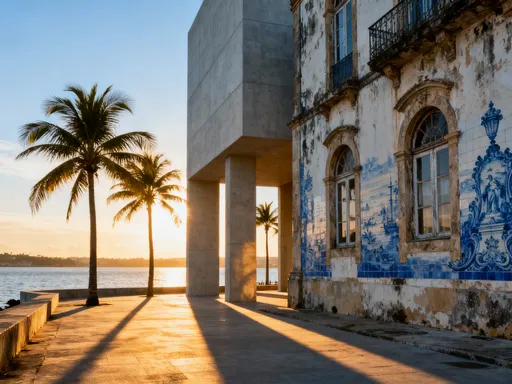
One of the most distinctive features of Portuguese architecture in Dili is the use of azulejos—glazed ceramic tiles often arranged in geometric or floral patterns. These tiles, typically blue and white, once adorned the facades and interiors of churches and government buildings. Though few remain intact due to humidity and lack of maintenance, fragments can still be found embedded in walls or preserved in restoration projects. Their presence speaks of a cultural fusion: European craftsmanship adapted to a Southeast Asian setting. Similarly, wrought-iron balconies with intricate scrollwork appear on some buildings, adding a delicate contrast to the heavy stonework. These details, though modest, reflect a desire for beauty and order even in a remote colonial outpost.
Preservation, however, remains a significant challenge. The tropical climate—marked by high humidity, salt air, and frequent rainfall—accelerates the deterioration of historic materials. Many colonial buildings have suffered from neglect, with roofs collapsing, tiles falling, and wooden elements rotting. Limited financial resources and competing national priorities mean that heritage conservation often takes a back seat to housing, healthcare, and infrastructure. Yet, there is growing awareness of the value of these structures. Local historians, architects, and community groups are advocating for documentation and careful restoration. Their efforts emphasize not nostalgia, but identity—preserving buildings as part of Timor-Leste’s cultural memory rather than as relics of foreign rule.
Indigenous and Vernacular Influences Beyond the Colonial Gaze
While colonial architecture dominates Dili’s central areas, the architectural soul of Timor-Leste lies in its rural villages and traditional building practices. Outside the capital, in mountainous regions and coastal communities, the *uma lulik*—or sacred house—stands as a powerful symbol of cultural continuity. These structures are more than dwellings; they are spiritual centers, repositories of ancestral knowledge, and sites of communal decision-making. Built from wood, bamboo, and thatch, they feature steeply pitched roofs designed to shed monsoon rains. The roof’s shape, often curving upward at the ends, carries symbolic meaning, representing the horns of the sacred buffalo, a central figure in Timorese cosmology.
Orientation is critical in traditional Timorese architecture. Houses are carefully aligned with cardinal directions, natural landmarks, or ancestral burial sites, reflecting a worldview in which the physical and spiritual realms are deeply connected. Communal spaces, such as open-air meeting platforms or shared courtyards, reinforce social cohesion. Even in urban informal settlements, echoes of these principles can be seen. Families often build homes on raised platforms to protect against flooding, using locally available materials like timber and palm thatch. The layout prioritizes airflow and shade, responding intuitively to the tropical environment without relying on mechanical cooling.
These vernacular forms subtly influence modern housing on the outskirts of Dili. Some newer homes incorporate steep roofs or elevated foundations, not as stylistic choices, but as practical adaptations rooted in tradition. In recent years, architects and planners have begun to study these indigenous techniques for their sustainability and climate resilience. The knowledge embedded in centuries-old building methods—passive cooling, rainwater management, and use of renewable materials—offers valuable lessons for a nation facing rising temperatures and extreme weather. Recognizing these influences shifts the narrative of architecture in Timor-Leste from one of colonial legacy to one of enduring local wisdom.
Post-Conflict Reconstruction and Modern Identity
The year 1999 marked a turning point for Dili’s built environment. Following the independence referendum, widespread violence led to the destruction of much of the city’s infrastructure. Government buildings, schools, churches, and homes were burned or looted. The urban landscape bore the scars of conflict, with entire neighborhoods reduced to rubble. In the aftermath, international aid poured in, and reconstruction became an urgent priority. The rebuilt city, however, took on a different character. Gone were many of the ornate colonial details; in their place rose functional, utilitarian structures made of concrete and steel. These buildings, though necessary, often lacked architectural distinction, reflecting the speed and pragmatism of post-conflict recovery.
Modern public buildings—ministries, hospitals, and administrative offices—were constructed with durability and cost-efficiency in mind. The architectural style leaned toward international modernism: flat roofs, blocky forms, and minimal ornamentation. While these structures met immediate needs, they also sparked debate about cultural identity. Was Dili becoming a generic capital, shaped more by donor priorities than local values? Some critics argued that the rush to rebuild sacrificed aesthetic and historical continuity. Others welcomed the new architecture as a symbol of progress and self-determination, a break from the colonial past.
In recent years, a more balanced approach has emerged. New public buildings increasingly incorporate subtle cultural motifs. The design of the Timor-Leste National Parliament, for example, integrates traditional patterns into its façade and uses locally inspired spatial arrangements. Similarly, some schools and community centers feature rooflines that echo the shape of the *uma lulik*, blending modern function with symbolic form. This evolution reflects a growing confidence in national identity—one that does not reject modernity but seeks to shape it with local meaning. The tension between speed and authenticity remains, but it is now part of a broader conversation about what Dili should become.
Sacred Spaces: Churches, Monuments, and National Memory
In a nation shaped by faith and resistance, sacred spaces play a vital role in public life. Dili’s religious and memorial architecture serves not only spiritual purposes but also acts as a vessel for collective memory. The Immaculate Conception Cathedral, one of the city’s most prominent landmarks, stands at the edge of Praça Dom Francisco. Its design blends modern concrete construction with a traditional spire, creating a silhouette that is both contemporary and reverent. Inside, the atmosphere is one of quiet solemnity, with natural light filtering through stained glass and wooden pews arranged in a semicircle. The cathedral has hosted pivotal moments in the nation’s history, from independence celebrations to funerals of national leaders, making it a living part of Timor-Leste’s journey.
Equally significant is the Santa Cruz Cemetery, a site of profound national importance. In 1991, a peaceful demonstration here turned into a massacre when Indonesian forces opened fire on unarmed civilians. Today, the cemetery is both a place of burial and a memorial. Simple stone markers bear names and dates, while larger monuments commemorate the victims. The space is carefully maintained, with flowers often placed at the foot of crosses. Visitors walk slowly, some in silence, others in prayer. The architecture of remembrance here is understated—no grand mausoleums or elaborate sculptures—yet its emotional weight is immense. It is a place where grief, dignity, and resilience converge.
Other memorials across Dili use space, inscription, and symbolism to convey national memory. The Resistance Museum, housed in a restored colonial building, displays artifacts, photographs, and personal stories from the independence movement. Its exhibits are arranged chronologically, guiding visitors through decades of struggle. Outside, a memorial wall lists the names of those who died for freedom. These spaces do more than preserve history; they shape identity. They remind citizens and visitors alike that Timor-Leste’s independence was not granted—it was earned through sacrifice. In their quiet presence, they affirm the value of peace, justice, and national unity.
Everyday Architecture: Markets, Homes, and Urban Adaptation
Beyond monuments and government buildings, Dili’s true character emerges in its everyday structures. The Mercado Municipal, or Municipal Market, is a vibrant hub of commerce and community. Stalls made of wood, metal, and canvas stretch across open-air pavilions, selling everything from fresh fish and tropical fruit to handwoven textiles and secondhand clothes. The market’s layout is organic, shaped by use rather than formal planning. Vendors adapt to weather and demand, moving canopies, sharing power sources, and creating shaded pathways. The air hums with activity—bargaining, laughter, the sizzle of street food. This is architecture not as design, but as life in motion.
Family homes in Dili’s neighborhoods reveal similar ingenuity. In informal settlements, residents construct houses from salvaged materials—corrugated metal sheets, repurposed shipping containers, and reclaimed wood. These materials are not chosen for style but for availability and resilience. Metal roofs withstand heavy rains, while raised floors protect against flooding. Windows are often simple openings, covered with shutters or cloth. Yet, even in modest homes, care is taken to create beauty: painted doors, potted plants, hand-carved furniture. These details reflect pride and dignity, even in conditions of limited resources.
Street vendors and small businesses operate from makeshift kiosks—wooden counters under tarps, converted bicycles, or repurposed shipping containers. These structures are temporary by design, allowing flexibility in a dynamic urban economy. Some entrepreneurs have turned containers into cafes or repair shops, adding windows, paint, and signage. This adaptive reuse is not just practical; it is a form of architectural innovation born of necessity. It demonstrates how people shape their environment to meet daily needs, using what is at hand. In these small acts of creation, resilience is built into the city’s fabric, one structure at a time.
The Future of Dili’s Urban Landscape
As Timor-Leste continues to develop, questions about Dili’s future urban form are gaining urgency. Rapid population growth, climate change, and economic pressures challenge the city’s ability to expand sustainably. Current urban planning efforts aim to balance development with preservation. The government, with support from international partners, has begun drafting long-term strategies for infrastructure, housing, and environmental resilience. These plans emphasize walkability, green spaces, and flood mitigation—critical concerns in a low-lying coastal city. However, implementation remains uneven, and informal settlements continue to grow on the urban fringe.
One promising direction is the integration of traditional design with climate-responsive architecture. Architects and researchers are studying how vernacular techniques—such as elevated foundations, natural ventilation, and thatched roofing—can inform modern building standards. These methods offer sustainable alternatives to energy-intensive cooling and imported materials. Pilot projects, including eco-friendly community centers and schools, are testing these ideas in practice. At the same time, local initiatives are working to document and protect architectural heritage. Oral histories, photographic archives, and mapping projects are helping to preserve knowledge before it is lost.
The vision for Dili is not one of imitation, but of innovation rooted in identity. The city need not choose between tradition and modernity; it can weave them together. Imagine public buildings with roofs inspired by the *uma lulik*, housing complexes designed for airflow and community, markets with shaded walkways and rainwater harvesting. These are not fantasies—they are possibilities grounded in existing knowledge and local needs. Dili is not a city defined by recovery; it is one actively shaping its future. Its architecture, in all its forms, reflects a nation learning to build not just structures, but a lasting sense of self.
Dili’s architecture is not about grand monuments—it’s a quiet, powerful dialogue between past and present. Each building, whether crumbling or new, carries meaning. To walk its streets is to witness a nation shaping its identity, one wall at a time. This is travel with depth: not just seeing, but understanding.