You Won’t Believe What This Ancient Mexican Pyramid Hides
Standing beneath the limestone steps of El Castillo at Chichen Itza, I felt the weight of centuries pressing down—not just from the stones, but from the genius behind them. This isn’t just a ruin; it’s a masterpiece of ancient astronomy and architecture. The way light dances on the pyramid during equinoxes, the eerie acoustics that carry claps into serpent-shaped echoes—every detail feels intentional. If you think pyramids are just big stone hills, wait until you see how this one *thinks*.
The First Glimpse: Arriving at a Living Monument
As visitors approach Chichen Itza through the dense Yucatán jungle, the landscape seems to exhale history. The air is thick with humidity and the faint scent of dry earth and greenery. Then, suddenly, the trees part like a curtain, revealing the Great Plaza in full view. At its center rises El Castillo, a pyramid so perfectly proportioned it appears almost unnatural against the flat horizon. It does not merely occupy space—it commands it. The scale is humbling. Towering over 30 meters high, the structure looms not as a relic frozen in time but as a living presence, still resonant with purpose.
For the ancient Maya, this was not simply a ceremonial site; it was a reflection of their understanding of the cosmos. The placement of Chichen Itza within the natural environment was deliberate. Unlike cities built along rivers, this urban center grew around sacred sinkholes called cenotes—especially the Cenote Sagrado, believed to be a portal to the underworld. The alignment of major structures with celestial events further underscores how deeply cosmology shaped their architecture. Even during centuries when foreign powers overlooked or misunderstood the site, local communities never forgot its significance. Oral traditions preserved knowledge long before archaeologists arrived with notebooks and cameras.
Today, Chichen Itza stands as one of the most visited archaeological zones in Mexico, yet its spiritual gravity remains undiminished. Walking into the plaza, one senses more than tourism—it feels like stepping into a conversation across time. The stones may be silent, but they are not empty. They hold memory, calculation, and intention. To experience Chichen Itza is not merely to observe an ancient city; it is to witness a worldview carved in limestone, where every angle, shadow, and echo tells a story about how the Maya saw themselves in relation to the sun, stars, and earth.
El Castillo: More Than Just a Pyramid
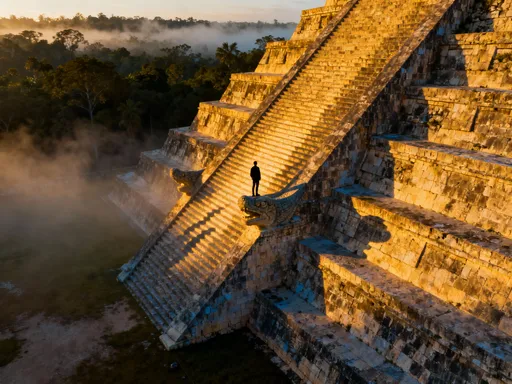
El Castillo, also known as the Temple of Kukulcán, is often photographed, but rarely fully understood. On the surface, it appears to be a stepped pyramid with staircases on all four sides. But beneath this familiar form lies a sophisticated integration of mathematics, astronomy, and religious belief. Each side of the pyramid features 91 steps, and when combined with the single step at the temple entrance atop, the total reaches 365—the number of days in the solar year. The nine terraces represent the nine levels of the Maya underworld, while the four staircases align with the cardinal directions, symbolizing the connection between the earthly realm and the heavens.
What elevates El Castillo from impressive monument to engineering marvel is its precise solar alignment. During the spring and autumn equinoxes, something extraordinary happens. As the sun sets, shadows cast along the northern staircase create the illusion of a serpent descending from the top of the pyramid to the base. This serpentine shadow joins a stone carving of a serpent’s head at the bottom, completing the image of Kukulcán—the feathered serpent deity—returning to earth. This effect is not accidental. It results from exacting calculations of solar angles and architectural orientation, demonstrating that the Maya were not only skilled builders but also advanced astronomers.
The phenomenon draws thousands each year, yet few realize the depth of planning behind it. The Maya did not build monuments to impress future tourists; they constructed them to function within a sacred calendar system. Temples like El Castillo served as physical calendars, marking time through light and shadow. The equinox event reinforced the cyclical nature of life, agriculture, and divine presence. In this way, the pyramid was not just a temple—it was a machine for measuring time, a bridge between human ritual and celestial order. Its precision speaks to a civilization that valued harmony between nature, religion, and science.
Hidden Acoustics: Clap Once, Hear a Secret
One of the most unexpected wonders of El Castillo is not seen—it is heard. Stand at the base of the northern staircase and clap your hands once. Instead of a simple echo, the sound returns as a series of rapid, high-pitched chirps, remarkably similar to the call of the quetzal bird—a creature sacred to the Maya and associated with divinity and freedom. This acoustic phenomenon has puzzled researchers for decades, and while the exact mechanism is still studied, evidence suggests it is the result of the pyramid’s precise geometry.
The stepped structure acts like a diffraction grating, scattering sound waves in a way that mimics avian vocalizations. Each tier reflects the clap at slightly different times, creating a cascading echo that our brains interpret as a bird’s cry. Scientists have measured these echoes and confirmed their similarity to the quetzal’s call, leading many to believe this effect was intentional. Could the Maya have designed the pyramid not only to align with the sun but also to resonate with symbolic sound?
This discovery transforms how we understand ancient architecture. Most ancient structures are celebrated for their visual grandeur or structural endurance, but El Castillo reveals a deeper layer: sound as sacred design. In rituals, a priest’s voice or a ceremonial drum might have produced echoes that enhanced the spiritual experience, making the temple feel alive. The acoustic properties may have been used to simulate the presence of gods or ancestors, turning auditory illusion into religious revelation. It reminds us that the Maya engaged all the senses in their sacred spaces—not just sight, but hearing, touch, and even the rhythm of footsteps on stone.
Modern visitors often rush through archaeological sites, snapping photos without pausing to listen. But at Chichen Itza, silence can be as revealing as sight. Taking a moment to clap, to hear the echo, is to participate in a 1,000-year-old conversation between humans and architecture. It’s a reminder that genius isn’t always loud—it can be a whisper bouncing off ancient steps, carrying meaning across centuries.
The Great Ball Court: Where Stone Spoke Law and Myth
Just east of El Castillo lies the largest known ball court in Mesoamerica, stretching nearly 168 meters long and 70 meters wide. Its sheer size is staggering, but more remarkable are the features that transformed it into a space of both sport and sacred drama. Two sloping stone walls rise over 12 meters high, each with a vertical ring carved from stone, positioned high above the ground. Players would have used their hips to propel a solid rubber ball through these rings—a feat requiring immense skill, strength, and precision. The game, known as *pok-ta-pok*, was more than entertainment; it was a reenactment of cosmic struggle, often tied to myths of life, death, and rebirth.
The carvings on the walls depict scenes of ritual sacrifice and divine intervention, showing decapitated players whose blood nourishes growing maize plants—a powerful metaphor for renewal. Some scholars believe the outcome of certain games determined political or religious decisions, while others suggest that high-stakes matches ended with the sacrifice of the losing team, honoring the gods through ultimate offering. Whether symbolic or literal, the ballgame was deeply embedded in Maya cosmology, representing the eternal battle between light and darkness, order and chaos.
Equally fascinating is the court’s acoustics. Due to the curvature and height of the walls, a whisper spoken at one end can be clearly heard at the other, over 150 meters away. This allowed rulers and priests to communicate across the field without raising their voices, reinforcing their authority and mystique. Imagine a captain receiving final instructions from a distant elder, or a priest’s chant echoing like a divine message across the arena. The architecture amplified not just sound, but meaning.
The Great Ball Court was a stage where sport, law, and myth converged. It was a place where physical prowess met spiritual duty, and where the outcome could influence the fate of a city. Today, the court stands in silence, but its design ensures that even without voices, it continues to speak. The lines of the walls, the position of the rings, the carvings of gods and heroes—all serve as a testament to a civilization that saw no separation between the sacred and the everyday.
Temples Beyond the Pyramid: The Observatory and Sacred Cenote
While El Castillo captures much of the attention, Chichen Itza is a complex of interconnected sacred spaces, each serving a distinct purpose. One of the most intriguing is El Caracol, a round tower unlike the angular structures typical of Maya architecture. Its name means “the snail” in Spanish, referring to the spiral staircase inside. But its true function was astronomical. The tower’s windows and doorways are aligned with specific celestial events, particularly the movements of Venus—the planet most closely associated with warfare and divine power in Maya cosmology.
Observations from El Caracol allowed priests to track Venus’s full cycle, which takes approximately 584 days. Knowing when Venus appeared as the morning or evening star helped determine auspicious times for battles, coronations, and ceremonies. The building’s elevated platform and narrow openings suggest it was designed to focus observation, minimizing distractions and maximizing accuracy. This was not astrology in the modern sense, but a precise science rooted in cycles and patterns. The Maya did not predict fate—they predicted motion, and in doing so, sought to align human actions with cosmic rhythms.
In contrast to the calculated precision of El Caracol is the Cenote Sagrado, a massive natural sinkhole located just north of the main plaza. Over 60 meters in diameter and plunging deep into the earth, this water-filled cave was considered a portal to Xibalba, the Maya underworld. For centuries, pilgrims came to offer treasures—jade, gold, pottery, and even human remains—as gifts to the rain god Chaac. Underwater excavations have recovered thousands of artifacts, confirming the cenote’s role as a major ceremonial site.
The juxtaposition of these two sites—El Caracol and the Cenote Sagrado—reveals the duality of Maya spirituality: one focused on observation and calculation, the other on mystery and sacrifice. One reached toward the stars, the other delved into the earth. Together, they formed a complete cosmological system, where knowledge and reverence walked hand in hand. Chichen Itza was not a single temple but a network of sacred functions, each structure playing a role in maintaining balance between the human and divine realms.
Building With Purpose: Materials, Labor, and Meaning
The construction of Chichen Itza was not the work of a single generation but the result of centuries of planning, labor, and cultural continuity. The primary material used throughout the site is limestone, quarried locally from the surrounding bedrock. Workers shaped the stone using harder tools made from obsidian and granite, then covered many surfaces with a fine layer of stucco, which was painted in bright reds, blues, and greens. Though much of the color has faded, traces remain, offering glimpses into the vibrant world the Maya inhabited.
One of the most distinctive architectural features is the corbel vault—a method of creating arched ceilings by gradually overlapping stones until they meet at the top. While not as structurally efficient as true arches, this technique allowed the Maya to build enclosed spaces without metal tools or the wheel. The precision required to balance each stone speaks to the skill of the masons, who worked with nothing more than measurement ropes and visual alignment. Walls were often built in phases, with new layers added over older ones during periods of renewal or expansion, embedding history within the architecture itself.
How the labor was organized remains a subject of study, but current understanding suggests that construction was carried out by trained artisans and seasonal workers, often as part of communal or religious duty rather than forced servitude. The effort required to transport materials, carve stone, and maintain alignment across vast plazas indicates a highly organized society with shared values and collective purpose. Building these monuments was not just an act of engineering—it was an act of faith, a way to honor the gods and ensure the continuity of the community.
What sets Chichen Itza apart from many ancient sites is the intentionality behind every choice. Nothing was arbitrary. The number of steps, the direction of doorways, the height of platforms—all were designed to reflect cosmological principles. Even the sound of footsteps or the fall of rain would have been considered within the sensory experience of ritual. To walk through Chichen Itza is to move through a carefully orchestrated environment, where form follows function, and function serves meaning.
Visiting Right: How to Experience the Genius Without Ruining It
As one of the New Seven Wonders of the World, Chichen Itza attracts hundreds of thousands of visitors each year. While tourism brings awareness and preservation funding, it also poses risks to the site’s integrity. Foot traffic, touching carvings, and unauthorized climbing can accelerate erosion and damage delicate stonework. To truly honor this ancient city, visitors must shift from passive observation to mindful engagement.
The best time to visit is early in the morning, shortly after opening, when temperatures are cooler and crowds are thinner. This allows for a more contemplative experience, giving space to listen, observe, and absorb the atmosphere. For those hoping to witness the equinox phenomenon, plan a visit around March 20 or September 22, but arrive well before sunset to secure a good viewing position. Guided tours led by certified archaeologists or cultural educators offer deeper insight than generic audio guides, helping visitors understand not just *what* they’re seeing, but *why* it matters.
Staying on marked paths is essential. Some areas, such as the upper levels of El Castillo, are closed to climbing to prevent wear and ensure safety. Respect these rules—not out of obligation, but out of respect for the site’s endurance and significance. Bring water, wear a hat, and move slowly. This is not a place to rush through. Pause often. Sit quietly. Listen to the wind, the birds, the echo of your own voice. Let the architecture speak.
Photography is encouraged, but consider what you’re capturing. Instead of only taking selfies in front of the pyramid, try framing shots that show detail—the texture of stone, the play of light on a carving, the alignment of a doorway with the sky. These images tell a richer story. Above all, approach Chichen Itza not as a checklist destination, but as a place of learning. The real reward is not a photo, but a shift in perspective—a recognition that human ingenuity, when guided by purpose and reverence, can create something that endures long after empires fall.
When Stones Still Speak
Chichen Itza is more than an archaeological site—it is a dialogue between past and present, built on precision, belief, and vision. The Maya did not construct monuments to be admired from afar; they built them to function, to teach, to align. In the shadows that form a serpent’s body, in the echo that mimics a sacred bird, in the silent observation of Venus from a round tower, their knowledge lives on. These are not ruins in the sense of decay, but records of a civilization that saw the universe as an ordered, interconnected system.
To visit Chichen Itza is to be invited into that system, to see the world through a different lens. It challenges the modern assumption that technological advancement is linear—that we are inherently smarter than those who came before. Here, mathematics, astronomy, acoustics, and spirituality were not separate disciplines but woven into a single fabric of understanding. The genius of El Castillo is not that it exists, but that it still communicates.
As travelers, we have a responsibility—to look deeper, to listen closely, to move with care. The real wonder of Chichen Itza is not just that it has survived, but that it still speaks. And if we take the time to listen, we might just hear something worth remembering.